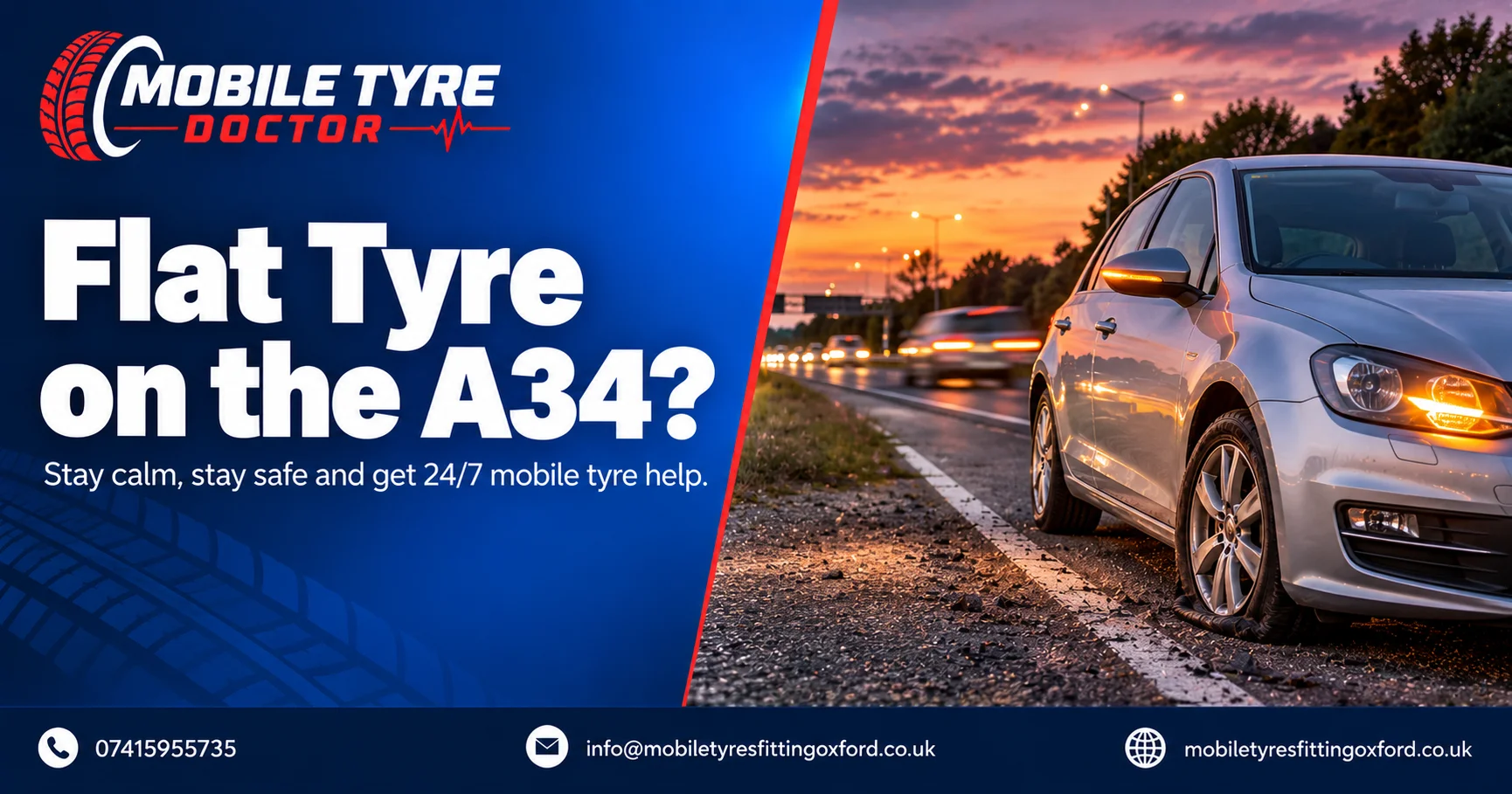
A flat tyre is stressful anywhere, but a flat tyre on the A34 or a busy stretch of the Oxford ring road can turn dangerous within seconds. Fast traffic, heavy lorries and very little room to pull over all raise the stakes. The good news is that a calm, well-ordered response keeps you and your passengers safe, and you never have to deal with the tyre yourself beside moving traffic. This guide explains exactly what to do, from the first moment the car starts to pull, to the point when a mobile tyre fitter in Oxford arrives and gets you moving again.
If you are stranded right now, call us on 07415955735. Once you are in a safe position, our team can arrange 24/7 roadside tyre repair to your exact location.
Why a Flat Tyre on the A34 Needs a Different Response
On a quiet residential street, a flat tyre is an inconvenience. On the A34, where traffic regularly travels at 60 to 70 mph, it is a genuine emergency. Vehicles approach quickly, lorries create strong air turbulence as they pass, and there is often only a narrow verge, or none at all. At speed, a failing tyre also pulls harder and heats up faster than it would at 30 mph, which leaves you less time to react.
Many drivers do one of two things by instinct: they brake hard, or they stop immediately wherever they happen to be. Both can make the situation worse, which is why a planned response beats a panicked one every time. The aim is to slow down gradually, reach the safest available place and then get everyone out of harm’s way.
Roads Where This Guide Applies
- The A34 between Oxford, Abingdon, Didcot and Newbury
- The A34, A40 and other fast sections of the Oxford ring road
- M40 junctions around Oxford and Bicester, and other busy approach roads
- Any fast dual carriageway where stopping is difficult
The First 60 Seconds: Recognise the Problem and Stay in Control
The first minute after a tyre starts to fail decides how the rest of the incident goes. Knowing the signs means you can react early instead of being surprised.
Signs You Have a Flat or Failing Tyre While Driving
- The car pulls to one side, even though you are holding the wheel straight
- A sudden vibration or rhythmic thumping that gets faster with speed
- The steering feels heavy, vague or unusually loose
- A flapping, rumbling or slapping noise from one corner
- The tyre pressure warning light comes on
- A smell of burning rubber
A tyre that is only low can often be caught before it fails. Our guide to the warning signs of damaged tyres shows what to look for before you set off.
Slow Down Gradually and Keep a Firm Grip
Hold the steering wheel firmly with both hands and resist the urge to correct sharply. Lift off the accelerator and let the car lose speed naturally. Then:
- Switch on your hazard lights and, where appropriate, signal towards the side you want to move to
- Check your mirrors and move across smoothly rather than swerving
- Brake lightly and progressively only once the car feels stable and speed has dropped
- Keep the engine running until the car has stopped, so you keep full steering assistance
Where to Stop Safely on the A34 and Around Oxford
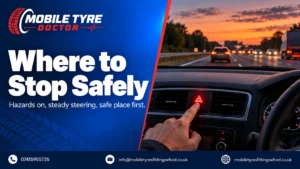
Where you stop matters almost as much as how you stop. Use the guidance below that matches the road you are on.
On the A34 and Other Dual Carriageways
If There Is a Lay-by, Hard Shoulder or Emergency Refuge Area
Head for the nearest lay-by, hard shoulder or emergency refuge area and pull in as far to the left as you can. Where space allows, turn the front wheels towards the verge, so that if the car is struck it is pushed away from the traffic rather than into it.
Once You Have Stopped
Apply the handbrake, switch off the engine and keep your hazard lights on. Do not inspect the tyre while you are close to moving traffic, because the flat tyre is not the main danger at this point. Passing vehicles are.
Getting Everyone Out of the Car Safely
If it is safe to get out and reach a safe place, leave through the doors furthest from traffic, normally the left-hand side. Move passengers well away from the car, behind any barrier or up the bank if there is one. If there are animals in the car, leave them inside unless that is unsafe, or keep them securely under control on the verge.
If There Is No Safe Place to Stop Immediately
Avoid stopping in a live lane if you can. If the tyre is flat but the car is still driveable, continue slowly with your hazard lights on to the next safe place, accepting that the tyre and wheel may be damaged. If you are forced to stop in a live lane and it is not safe to get out, stay in the vehicle with your seat belt on, keep your hazard lights on and call 999.
On the Oxford Ring Road and City Roads
On slower roads you have more choice. Pull into a side road, car park, petrol station forecourt or a wide, level lay-by. Avoid stopping on bends, near the brow of a hill, in a bus lane or close to a junction, where other drivers cannot see you in time. Keep your hazard lights on, apply the handbrake and wait somewhere safe, away from the traffic.
If You Are on the M40 or Another Motorway
Motorways have their own rules. Use an exit or service area if safely reachable, otherwise an emergency area or hard shoulder. Leave via the left-hand doors only if safe, and wait well away from traffic. Never attempt to change a wheel on a motorway. Use an emergency phone or call National Highways or your breakdown provider so that they know exactly where you are. Our motorway tyre assistance page explains how we help drivers once they are in a safe position.
Follow the Highway Code breakdown guidance. Before leaving a motorway emergency area, use its emergency telephone and follow the operator’s instructions.
Why You Should Not Change the Wheel Yourself Beside Fast Traffic
Even confident drivers should think twice about changing a wheel at the side of a fast road. A wheel change takes time, keeps you close to traffic and relies on a jack that needs firm, level ground. On a sloping verge or soft ground, the risk of the car slipping is real.
The Hidden Risks of a Roadside Wheel Change
- Passing vehicles and lorry turbulence only a short distance from where you are working
- Soft, sloping or uneven ground that makes a jack unstable
- A locking wheel nut with no key, which can stop the job completely
- Over- or under-tightened wheel nuts, which can be dangerous later
- Poor light, bad weather and fatigue, especially at night
Space-Saver Spares and Tyre Sealant: Know the Limits
A space-saver spare is a short-term measure only. It usually carries a maximum speed marked on the wheel, often 50 mph, and it should be replaced as soon as possible. Tyre sealant is designed for small tread punctures and will not help with sidewall damage or a burst tyre. In every case the damaged tyre should be inspected, and often a mobile tyre replacement is the safest answer.
Your Step-by-Step Flat Tyre Emergency Plan
- Hold the wheel firmly, ease off the accelerator and avoid sudden braking or steering.
- Switch on your hazard lights and signal your intention to move over.
- Slow down gradually until the car is stable and moving at a low speed.
- Move to the safest available place: a lay-by, hard shoulder, emergency refuge area or side road.
- Park, apply the handbrake and switch off the engine, with the front wheels turned towards the verge where appropriate.
- If it is safe to leave, use the side furthest from traffic and wait well away from the road. If you cannot reach safety, stay belted in with hazards on and call 999 for the police.
- Call for help, and give your exact location, vehicle details and tyre information.
- Stay clear of the car until the fitter arrives, then check pressures and the other tyres before you drive away.
Staying Safe While You Wait for Help
Make Yourself Visible
Keep your hazard lights on, and wear a high-visibility jacket if you have one. On roads that are not motorways, a warning triangle placed at least 45 metres behind the vehicle can warn other drivers, but only if it is safe to do so. Never use one on a motorway, and never walk into a fast carriageway to place one on a road like the A34.
Choose the Right Place to Wait
Stand well away from the car and the carriageway, behind a barrier or up a bank where possible. Keep children close and stay alert to traffic. If the weather is cold, a safe position away from the road is better than sitting in a car that is close to moving vehicles.
What to Tell the Tyre Fitter When You Call
The clearer your information, the faster we can reach you with the right tyre. Have these details ready:
- Your exact location: road name, junction, marker post or nearby landmark, and your direction of travel
- Your vehicle make, model and registration
- The tyre size printed on the sidewall, if you can read it without going near live traffic
- Whether the tyre is flat, shredded or damaged on the sidewall
- Whether your car has locking wheel nuts and where the key is kept. If you have lost it, read our guide to locking wheel nut removal.
How a Mobile Tyre Fitter Gets You Back on the Road
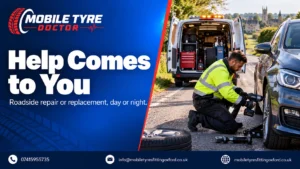
Once you have called, the job becomes simple. Mobile Tyre Doctor brings the equipment and a wide stock of budget and premium tyres straight to you, at a safe, accessible location. Recovery may be needed first if the vehicle is in an unsafe position. We aim to reach most Oxford locations within 20 to 30 minutes, depending on traffic and availability, and our prices start from £80 depending on the tyre type and the service required. You can learn more about our approach on our About page.
When the Tyre Can Be Repaired
If the damage is a puncture in the tread area, the tyre can often be repaired on the spot. Our mobile puncture repair and mobile tyre repair services are designed for exactly this. For more on what to do once the puncture is repaired, see our guide on what to do after a tyre puncture.
When the Tyre Must Be Replaced
Sidewall damage, bulges, cuts and tyres that have been driven on while flat cannot be repaired safely. In those cases your fitter will recommend a new tyre. If your tyre failed suddenly, our guide to a tyre blowout explains the causes and what to check afterwards.
Areas Along the A34 and Around Oxford Where We Help
We cover Oxford and the surrounding villages and towns, including the roads that feed onto the A34 and the ring road. Find your area below, or browse our full list of mobile tyre services in Oxford.
West and north-west of Oxford: Botley, Cumnor, Godstow, Binsey, Eynsham and Woodstock.
South along the A34: Abingdon, Didcot, Wantage, Newbury and Winchester.
North and the M40 corridor: Bicester.
After the Tyre Is Fixed: Check Before You Drive On
Before you rejoin fast traffic, take a minute to check the basics:
- Confirm the new or repaired tyre is at the pressure shown on your door-jamb sticker or in the vehicle handbook
- Look at the other tyres, especially the one on the same axle, for damage or low pressure
- If the car vibrates at speed, ask about wheel balancing
- Restock your car with the items you used, and check where your locking wheel nut key is stored
For more practical advice, visit our Tyre Safety Guide and browse our latest tyre advice articles.
How to Reduce the Risk of a Flat Tyre on Busy Roads
- Check your tyre pressures monthly, when the tyres are cold
- Inspect each tyre for nails, cuts, bulges and uneven wear
- Slow down for potholes and avoid kerb strikes
- Do not ignore the tyre pressure warning light
- Keep a charged phone, a torch and a high-visibility jacket in the car
- Replace worn tyres before they reach the 1.6 mm legal minimum tread depth
Slow, unnoticed pressure loss is one of the main reasons tyres fail without warning. If you want to know what happens when a tyre goes completely, read our guide to tyre blowouts.
Frequently Asked Questions
Can I keep driving on a flat tyre to get off the A34?
Only as far as you need to reach the nearest safe place, and only slowly with your hazard lights on. Driving further on a flat tyre quickly destroys the tyre and can damage the wheel, so stop as soon as it is safe to do so.
Should I call 999 for a flat tyre?
Not normally. Call 999 only if you are in danger, for example if you are stuck in a live lane and cannot leave the vehicle safely. In most cases, move to a safe place and call a breakdown service or a mobile tyre fitter.
How quickly can a mobile tyre fitter reach me on the A34?
We aim to reach most Oxford locations within 20 to 30 minutes, depending on traffic and availability. Give us your exact location and direction of travel so we can find you quickly.
How much does emergency tyre fitting cost in Oxford?
Mobile tyre fitting prices in Oxford start from £80, depending on the tyre type and the service required. Call 07415955735 for a quote based on your tyre size and situation.
Can a flat tyre be repaired at the roadside?
Often yes, if the damage is a puncture in the tread area. Sidewall damage cannot be repaired safely and needs a mobile tyre replacement. Our fitter will inspect the tyre and tell you which applies.
What if I do not have the locking wheel nut key?
Do not try to force the nut. Tell us when you call so we can plan the right tools, and see our guide to locking wheel nut removal for more detail.
Is your mobile tyre service available at night?
Yes. Our 24/7 mobile tyre fitting service runs day and night, seven days a week, across Oxford and the surrounding area.
Stuck With a Flat Tyre? Call 24/7 Mobile Tyre Fitting in Oxford
Do not risk changing a wheel beside fast traffic. Get to a safe place, then call Mobile Tyre Doctor on 07415955735 and we will bring a fitter and the right tyre to you. You can also contact us online or return to our Mobile Tyre Fitting Oxford homepage to see everything we offer.